2016年7月27日星期三

What is the brightest h4 headlight bulb?


Now everything wants the brightest h4 headlight bulb for their own car or vehicles ,while what is the brightest one and how to choose the bulbs ?

Most of people know that the power and lumen stand for the brightness for headlight bulbs and most of them only check the power and lumen when they buy it ,while cause of that many sellers know this and then some of them write the power and lumen much higher to attract the customers to buy it .  So even they do not write high ,it has some loss and it has a raw lumen and effective lumen. So when you are buying it ,you can ask the seller the effective power and lumen and also the test report

After checking it and you need to test it by yourself ,of course it is check the lighting performance when you install.  

This is still not enough ,cause some lights are very bright at the beginning ,but after you use for some days ,it is not bright any more.This is the problem of luminous attenuation and heat dissipation ,while how to check the luminous attenuation ? Usually you can check it by the led chip ,try your best to buy the genuine brand led ,such as CREE,Philips which is higher luminous attenuation. The best heat dissipation is still the fan up to now

So the best brightest h4 headlight bulb is CREE or Philips led headlight with fan


1.Jeep Headlight Wiring Harness

Most stock components on a vehicle are designed to a specific level of performance and nothing more. The factory headlights on a Jeep TJ are no exception. They do exactly what they were intended to do: They light up and allow you to see a little way down the road.
We realized pretty quickly that the stock, yellowish, headlights simply were not going to cut it. But, we also wanted more with this Jeep than the usual Sylvania Silverstars upgrade could give us. Once we started shopping for aftermarket headlights, it readily became apparent that any quality aftermarket light would be a substantial improvement, but to fully realize their potential the worn out stock wiring would need to be addressed.
Taking a voltmeter to our project vehicle, and a couple others, we found the power actually making it to the headlights (measured with the engine running and the headlights on) was about 12 volts on our TJ and as low as 9 volts on an older XJ. None of them actually showed us the full 14 volts we measured at the battery. So before we get into swapping in new bulbs, lets go through building the foundation for some really kick-butt headlights.


2016年7月14日星期四

Should We Change our lights into LED?


Drivers may soon notice brighter and whiter headlights on the road as the popularity of traditional halogen headlights continues to dim.Halogen still ranks highest as the most common headlight on the market, but several alternatives, including xenon-based and light-emitting diode (LED) headlights, are growing in popularity. Here's how the options compare in terms of performance, safety and price.
  According to Motor Trend, you'll notice several important differences in light produced by LEDs, xenon and halogen headlights. LEDs have the coolest color temperature at around 6,000 Kelvin, which makes them appear whiter than daylight. Xenon headlights come in at around 4,500 K, while halogens round out the list at a yellowish 3,200 K.When it comes to reflection, LEDs offer better light return from road signs, while xenon lamps better illuminate the sides of the road. In part, this is because xenon lamps typically produce more light, measured in lumens, than LEDs.Both LEDs and xenon provide a large pattern of light on the road, whereas halogens offer a small pool of yellow light directly in front of the vehicle. If you're buying a new car, expect LED headlights to be the premium option, and make sure your auto repair shop is equipped to handle LED headlight replacements and repairs.If you're looking for intense light and don't mind the glare, xenon may be the best choice. LEDs, meanwhile, offer great light, low power and long life, but often come with a bigger price tag.
  LEDs are the most recent innovation in headlight technology. Instead of gas and filaments, LEDs rely on small diodes that produce light when electric current excites their electrons. They need an low amount of power to work but do produce a significant amount of heat on the diode. This requires heat control systems at the bottom of the headlight and near other car components. If this system fails, not just the light, but other electronics could be affected.The small size of LEDs means they can be formed into almost any shape, and their light is naturally directional rather than diffuse, making them an excellent choice for headlights.

2016年7月4日星期一

What are the differences of the beam pattern?


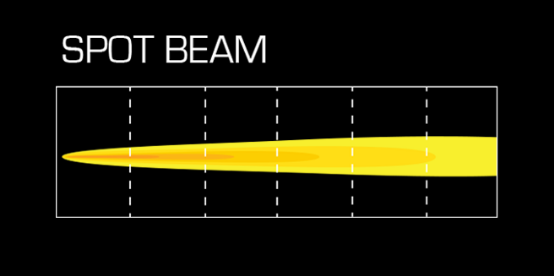
There are many types beam pattern for led work driving light and led light bar,while the most popular and widely used is these 4 types: Spot (Long Range), Driving and Spread, Fog, and Flood.

Spot Beam (Long Range): Spot or Long Range lights are able to penetrate deep into the night. KC Long Range Lights produce a tighter, more focused circular beam of light (pencil beam) to see way out ahead toward the horizon even at higher speeds. These lights create an extremely bright, hot center beam pattern. Spot beam lights are typically used for Off Highway, Commercial, Agricultural and Racing applications.

Driving and Spread Beam: Driving lights are designed to supplement your high beam headlights.  KC's Driving lights all comply to both SAE and ECE regulations and requirements and are street legal. KC Driving Lights produce a rectangular shaped beam pattern that can reach further and wider than your headlights.  Driving lights are very useful to create visibilty near the sides of roadways and out in front of the vehicle. They are great for all around trail riding as well.

Spread beam lights are similar to Driving but tend to be brighter, wider and possibly taller as they are not required to follow specific SAE or ECE safety standards.  Spread beam lights are great lights for multi-purpose off-road use.


Fog Beam: Fog lights are intended to be mounted below the headlights and project a beam pattern which is very wide horizontally and narrow vertically usually called a cut-off. This pattern lights up a pathway close to the ground but does not light the airborne particles in the line of sight while driving - this increases the visibility in harder to see conditions. KC Fog beams are very useful in Dust, Fog, Rain and Snow. They also work well as Cornering lights in clear conditions and are optically designed to increase visibility in tandem with your primary headlights.

Flood Beam: Flood beams create a large wide pattern of light that floods an area with an extremely tall vertical and wide horizontal light pattern. These lights are typically used as work lights and back-up lights to see a broader area at shorter distances.


Pls choose the right beam pattern for your application

Trapezoidal Beam:The trapezoidal beam (shown in dotted lines) is an ideal, general-purpose work light designed with a narrower pattern for longer visibility


2. Five things to consider before buying car led lighting
When your halogen car lighting is not enough bright as you want, it's a good time to consider switching to LED.
LEDs have an impressive lifespan (50000hours!) and are very cost-effective.
Now's the right time to switch to LEDs. These bulbs have made significant advances over the last few years, Because there are so many LED varieties, choosing an LED is entirely different from many types. Before you head to the store, find out what you need to know about choosing the right LED bulbs.

Lumens, not watts

Forget what you know about halogen -- your watts are no good here.
When shopping for bulbs, you're probably accustomed to looking for watts, an indication of how bright the bulb will be. The brightness of LEDs, however, is determined a little differently.
Contrary to common belief, wattage isn't an indication of brightness, but a measurement of how much energy the bulb draws. For incandescents, there is an accepted correlation between the watts drawn and the brightness, but for LEDs, watts aren't a great predictor of how bright the bulb will be. (The point, after all, is that they draw less energy.)
For example, an LED bulb with comparable brightness to a 60W incandescent is only 8 to 12 watts.
But don't bother doing the math -- there isn't a uniform way to covert incandescent watts to LED watts. Instead, a different form of measurement should be used: lumens.
The lumen (lm) is the real measurement of brightness provided by a light bulb, and is the number you should look for when shopping for LEDs.

Choosing the right color LED

You can always count on halogen providing a warm, yellowish hue. But LEDs come in a wide range of colors
.

Candace Lombardi/CNET
As shown off by the Philips Hue, LED bulbs are capable of displaying an impressive color range, from purple to red, to a spectrum of whites and yellows. For the home, however, you're likely looking for something similar to the light that incandescents produce.
The popular colors available for LEDs are "warm white" or "soft white," and "bright white."
Warm white and soft white will produce a yellow hue, close to incandescents, while bulbs labeled as bright white will produce a whiter light, closer to daylight and similar to what you see in retail stores.
If you want to get technical, light color (color temperature) is measured in kelvins. The lower the number, the warmer (yellower) the light. So, your typical incandescent is somewhere between 2,700 and 3,500K. If that's the color you're going for, look for this range while shopping for LED bulbs.

You'll pay more for an LED bulb

LED bulbs are like hybrid cars: cheaper to operate but pricey upfront.
When switching to LED bulbs, don't expect to save buckets of cash. Instead, think of it as an investment. Luckily, competition has increased and LED bulbs have come down in price (like this $5 LED from Philips), but you should still expect to pay much more than an incandescent.
Eventually, the LED bulbs will pay off, and in the meantime, you'll enjoy less heat production, longer bulb life, and even the option of controlling them with your smartphone.
Bottom line: unless you're replacing many incandescent bulbs in a large house, you won't see significant savings in your electricity bill.
For a detailed breakdown of the cost-effectiveness of LED bulbs, check out this useful post.

Watch out for non-dimmable LEDs

Because of their circuitry, LEDs are not always compatible with traditional dimming switches. In some cases, the switch must be replaced. Other times, you'll pay a little more for a compatible LED.
Most dimmers, which were likely designed to work with incandescents, work by cutting off the amount of electricity sent to the bulb. The less electricity drawn, the dimmer the light. But with your newly acquired knowledge of LED lingo, you know that there is no direct correlation between LED brightness and energy drawn.
This guide explains why some LEDs will hum, flickr, or buzz when tied to a dimmer.
If you'd like your LED to be dimmable, you need to do one of two things: find LED bulbs compatible with traditional dimmers, or replace your current dimming switch with a leading-edge (LED-compatible) dimmer.
When shopping for LEDs, it helps to know what kind of dimming switch you have, but if you don't know (or would rather not go through the trouble), simply search for LED bulbs compatible with standard incandescent dimmers. To make things easier for you, we tested a slew of them to find out which LED bulbs work best with dimmers.

Not all light fixtures should use LEDs

Knowing where it's OK to place an LED will ensure that the bulb won't fizzle ahead of its time.
You probably know that LED bulbs run dramatically cooler than their incandescent cousins, but that doesn't mean they don't produce heat. LED bulbs do get hot, but the heat is pulled away by a heat sink in the base of the bulb. From there, the heat dissipates into the air and the LED bulb stays cool, helping to keep its promise of a very long life.
And therein lies the problem: the bulb needs a way to dissipate the heat. If an LED bulb is placed in an enclosed housing, the heat won't have anywhere to go, sending it right back to the bulb, and sentencing it to a slow and painful death.
Consider where you'd like to place your LED bulbs. If you have fully or semi-enclosed fixtures you need to light up, look for LEDs that are approved for recessed or enclosed spaces.
3.5 steps you should know before buying led work light
A work light is used in a particular job-related situation, such as for automobile mechanics repair, theater technical setup, mining and marine applications. It can also be used for automotive lighting, patrolling, hunting and other moving environments. When you choose a work light, youd better consider the specifications in terms of your working environment.
To judge if the LED work light you are considering is the best choice for you, there are some features that you can compare.
1) Type (Beam pattern)
The first thing you should notice is the type of light. Consider what type you want, floodlight, flashlight or off-road light. Floodlight is widely used to provide wide-angle lighting for outdoor work in construction sites and other facilities. Flashlight is widely used for emergency lighting and is usually rechargeable. Off-road light is applied to automotive lighting. So choose the type of work lamp according to the purpose of your project. Then you should narrow your choice according to the following features.

2) Size
The size of the device is critical. In certain work situations, the space is limited, so you cannot choose a bulky work light, otherwise you will not have enough space to operate. Of course, when space is sufficient, the lamp size will not be an issue.
The size is from 2inch to 9inch,pls choose the one suitable for your device
3) Power & heat output
If your work needs intense bright light especially in industrial and mining areas, construction sites and so on, you should choose a high-power work lamp. The higher the power is, the higher the intensity is. However, a higher power usually transforms to higher heat generation. If a light emits a lot of heat, the space will be too hot for the device to function properly and people will feel uncomfortable, especially in a narrow room. So you should balance the power and heat output to reach a best combination for your work conditions.
4) Power supply
Most flashlights use dry batteries as power supply. Then you will need to replace the batteries from time to time when they run out of power. Some work lights work on built-in rechargeable batteries. For this type of light, it is be important to know the operating time and the recharging time. In addition, the available chargers might influence your decision, too. A rechargeable work light is often sold with an AC charger or car charger or both.
5) Fixation. 
Another vital factor is how the LED work light is kept in position. Work lights come in varieties of designs, including bar light with a hook on one end, hand-held flashlight, floodlight with a handle, lamp on a tripod and a lot more. So find the most convenient method for you to place the work lamp and choose the best fit design and feature accordingly.
There may be other features that you need to consider, such as waterproof grade, slip-resistance, shock-proof, overcharge protection, rotation and so on.



2016年6月27日星期一

Brexit,What's Your Next Move?

The UK is China's second largest trading partner in the EU, and traders are worried that a British exit from the Union could mean trouble.
Data from China's Customs show the country exported 370 billion yuan worth of goods to the UK in 2015, a 5.5 percent growth from the previous year. The UK was the only country among China's major trade partners in the EU to see an increase.
China and UK has also strengthened cooperation in several areas since October last year, when President Xi Jinping visited the country. One professor who studies the relations between China and Europe says, however, that he isn't too worried about the UK's upcoming decision.
bilateral trade and financial cooperation between China and UK is very strong. And London is also the offshore center for RMB settlement. So a British exit may not have much of an influence on the ties between China and the UK as thought.
Ratings agency Standard and Poor's has warned that a UK exit from the EU might endanger sterling's status as an international reserve currency, and therefore threaten the country's credit ratings.
The World Trade Organization says that if the UK decides to leave the EU, it will cost the country's consumers an extra 9 billion pounds every year in import duties.
And for most .
perhaps the lower pound will lure a few more tourists . And for most chinese traders to UK may be more profit than ever before as well as more challenging.
And for most UK traders, if you wanna save more money and keep your profit, its time to cooperate with the factory .and we would be your perfect choice if you get to know more about us. If you are interested,you are welcome to contact with us for more details.

What is IP Rating(Ingress Protection Rating)?


All the buyers of car led lighting especially the offroad led lighting :led light bar ,led work light ,jeep headlight and led headlight will concern the waterproof problem IP Rating ,here let you know more about IP Rating

IP Rated Enclosures

First Digit (intrusion protection)
0 No special protection
1 Protection from a large part of the body such as a hand (but no protection from deliberate access); from solid objects greater than 50mm in diameter.
2 Protection against fingers or other object not greater than 80mm in length and 12mm in diameter.
3 Protection from entry by tools, wires etc, with a diameter of 2.5 mm or more.
4 Protection against solid bodies larger than 1mm (eg fine tools/small etc).
5 Protected against dust that may harm equipment.
6 Totally dust tight.

Second Digit (moisture protection)
0 No protection.
1 Protection against condensation.
2 Protection against water droplets deflected up to 15from vertical
3 Protected against spray up to 60from vertical.
4 Protected against water spray from all directions.
5 Protection against low pressure water jets (all directions)
6 Protection against string water jets and waves.
7 Protected against temporary immersion.
8 Protected against prolonged effects of immersion under pressure.

In Summary:
IP65 Enclosure - IP rated as "dust tight" and protected against water projected from a nozzle.
IP66 Enclosure - IP rated as "dust tight" and protected against heavy seas or powerful jets of water.
IP 67 Enclosures - IP rated as "dust tight" and protected against immersion.
IP 68 Enclosures - IP rated as "dust tight" and protected against complete, continuous submersion in water.


2.Why choosing COB LED Headlight?
As the led headlight development for 3 years till now ,it has update from all in one design ,optional colors design,fanless design and to the current cob design ,all of this is the prove of the led headlight rapid development
What is COB?
COB (Chips on Board) is a new technology of LED packaging of LED light engine. Multi LED chips are packaged together as one light module. When it lights up, it looks like a lightinpanel.
How COB LED light source works?
In COB lighting, single LED chips are placed directly on a circuit board (or substrate) which has thermal properties to disperse heat. Heat dissipation is a very important aspect of LED lighting since it can have a major impact on the life expectancy of the luminary. Therefore, COB lighting can have a higher LED chip density and achieve higher light level while maintaining or improving life expectancy.
Advantage of COB:
COB lights are a more efficient form of LED lighting for general or automotive lighting applications because:
- light has a more uniform appearance
- better life expectancy
- achieve higher light level over a large area
- COB is more stable and reliable than standard LED package
- Cheaper cost and competitive price


3.Top 10 reason for choosing LED Headlights for cars

LED headlights are on the rise, and motoring commentators expect that more vehicles will sport LEDs into the future, as manufacturers and car owners alike trend away from cheaper, less-efficient bulbs. There are dozens of reasons to make the switch to LED headlights for a better motoring experience, and given the increasingly accessible cost of these once-expensive headlights, it is becoming ever-more affordable for people to upgrade.
If youre thinking about making the switch to LED headlights, here is a run-down of the top 10 reasons people are choosing to upgrade, and the advantages you can benefit from, simply by switching out your old headlights for an LED headlights kit.
20mins installation
LED headlights kits are easy to install, and you dont need to be a mechanic or have any particular technical skills to install these on your own car. In fact, it is possible to fit headlights with minimal tools and around 30-60 minutes of your time, saving on the labor costs of getting your headlights fitted out. Or, if you dont feel confident installing these yourself, you can also take your kit to any mechanic, who will be able to fit these at low cost. All our kits come with full installation instructions too, guiding you through the process step-by-step to installing your headlights.
No need start up time
As the HID/xenon headlamp for car need the ballast to get a higher voltage at 22000V to start the headlight, usually it will need 1-10 seconds
While LED headlamp doesnt have this problem now and it can work at once after you install of it

Longer lifetime
The average LED light can be used continuously for 11 years, or 22 years at 50% activation. That compares with just 5000 hours for a typical halogen headlight, which are also more prone to failure over the course of their life, on account of their moving parts. LED headlights are therefore significantly more hardwearing and long-lasting than traditional halogens, which remains a key element of their appeal.
Engery Save
Because LEDs are so much more energy efficient than halogen and other headlights, they draw less energy from your vehicle to produce a purer quality of light. This has the net effect of improving your fuel efficiency, which will save you money. When you multiply these marginal savings over the full lifecycle of your LED headlights, this money goes some way towards repaying the cost of your headlights kit.
These are just a few reasons more motorists are choosing to switch to LED headlights, and industry projections expect an increasing number to switch to LED headlights in the years to come. For a long-term, efficient, high quality solution for any car, choose LED headlights in preference to standard halogen bulbs.
Friendly Environment

The HID/Xenon car headlight bulbs has mercury inside of it ,while mercucy is harm to environment and people ,so now many countries are banned for HID headlight,such as USA

LED has solved the problem of it ,it doesnt have any harmful substance

No Need To Replace Bulbs
Of course, not replacing your headlights or bulbs is in itself an advantage, saving you the effort of switching out your headlights on a regular basis. This means there is no need for ongoing maintenance to your headlights, or for periodic refits if a bulb blows. This saves time and hassle on the replacement process, so you dont have to switch out your bulbs every year or so - not to mention saving additional expense.

More Efficient Lighting

In terms of the lighting LED headlights produce, it is created with significantly greater efficiency than with halogen bulbs. Whereas halogen bulbs waste 80% of their energy (by generating excessive heat as a byproduct of creating the glowing light), LED lights convert 80% of the energy they use directly into light, wasting only 20% in the process - significantly more efficient. This means you can benefit from stronger lighting, with a lesser load on your alternator.

Cheaper To Operate

Because LED headlights are significantly more efficient, they are cheaper to operate. Further, because you may only have to replace LED headlights as often as you change your car, they are significantly cheaper to buy and maintain over the total lifecycle of your headlights. This represents several cost savings over halogen bulbs, which manufacturers use because their initial component cost is lower than with LED headlights. So as well as benefiting from more effective lighting on the road ahead, you can also save money into the bargain.

Build Quality

Our solid-state LED headlight kits are built to exacting standards, ensuring they can realise their full potential over long-term use. With no moving parts, as with traditional bulbs, you are much less likely to need to switch out your headlights over the course of their lifecycle. Our high-quality components are manufactured to last, so when you switch in your LEDs, you can rest assured in the quality of your headlights.

Safer To Use

Consider a night-time driving scenario, or foggy road conditions. Rather than a weak, yellow halogen light which illuminates just a few feet directly ahead, or even reflects against dense fog, LEDs produce a much more penetrating, illuminating white light. This results in clearer driving conditions ahead, while making it much easier to see in fog and other poor visibility conditions. As a result, drivers with LED lights have more time to react to changing conditions ahead, and therefore can be sure they are as safe as possible on the roads.

Better Lighting Quality

Aside from being brighter, that actual quality of light from LEDs is greater than the quality of light available from halogens. Rather than a weak, watery yellow light, LEDs produce a much more piercing, clearer quality of light. This is warmer than HID xenon bulbs too, so more illuminating and less blinding for other road users. For the optimal lighting quality from your headlights, choose LEDs.